The beginner's guide
What is Model UN?
Model United Nations is an academic simulation of the real UN. Each student is assigned a country, joins a committee debating a real global issue, and spends a conference researching, speaking, negotiating, and drafting until the room votes on a written resolution. Roughly 400,000 students take part every year across hundreds of conferences worldwide, from school cafeterias to university-hosted events with thousands of delegates.
This page is the plain-English version of everything a student, parent, or teacher usually wants to know before their first conference, with links into our deeper guides where a topic deserves its own page.
How a committee actually works
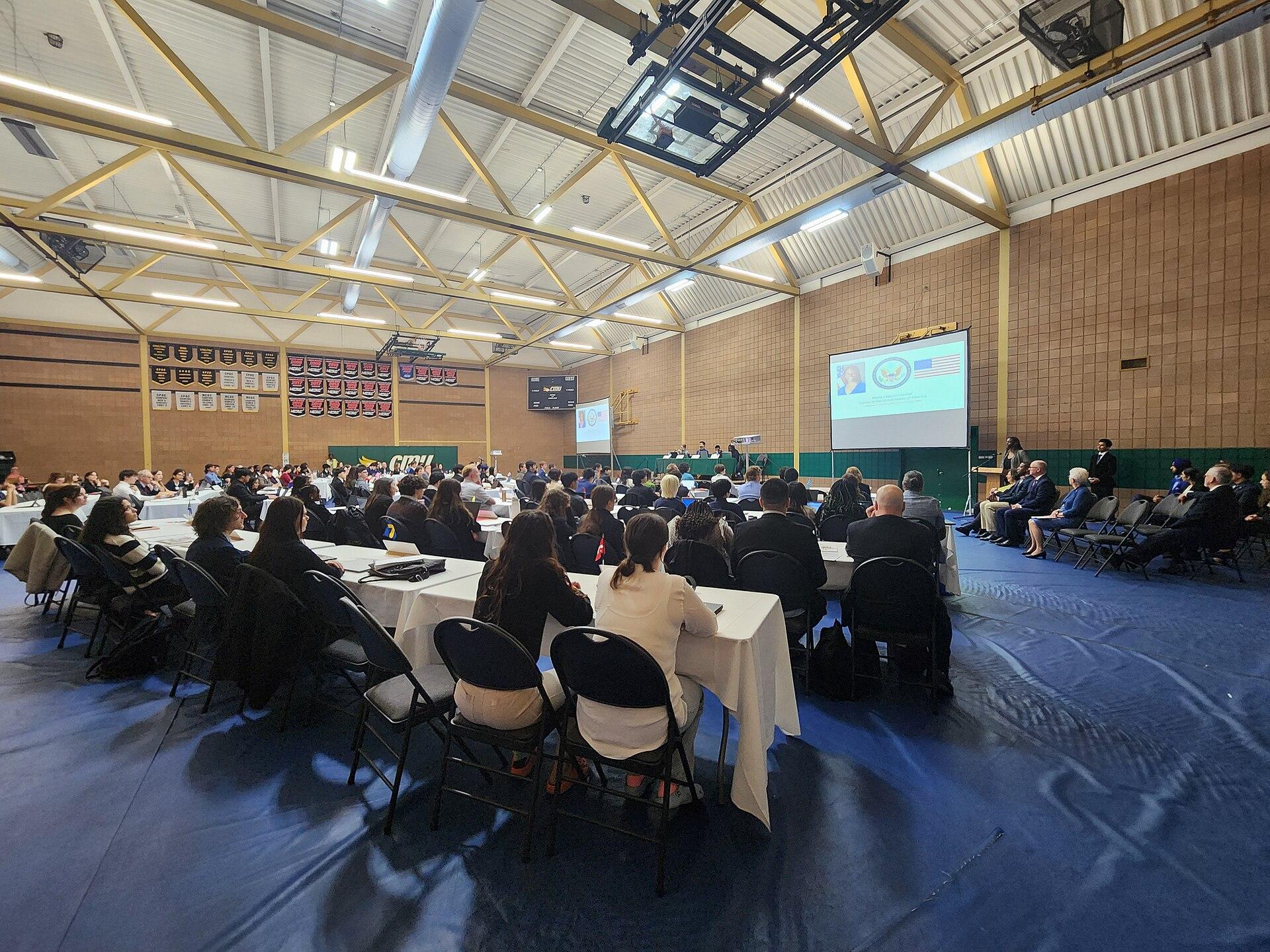
Strip away the vocabulary and a Model UN committee is a structured group negotiation. The chair calls the room to order and takes roll. The committee votes on which topic to debate first. Then debate alternates between three modes: formal speeches from a speakers list, rapid exchanges on narrow questions (moderated caucuses), and unstructured negotiation time where delegates leave their seats, form blocs, and write (unmoderated caucuses).
The writing converges into draft resolutions: formal documents proposing what the committee should do about the topic. Blocs merge drafts, fight over amendments, and eventually the committee closes debate and votes. A resolution that wins a majority passes, and the committee moves to its next topic. That loop, speak, negotiate, write, vote, is the whole game. The full procedural version lives in Model UN Rules of Procedure, Explained in Plain English.
What a delegate actually does
The delegate's job has a before and a during. Before the conference: research your assigned country (its government, allies, and record on the topic) and write a position paper stating what your country wants done. During the conference: deliver an opening speech, speak in caucuses, build a bloc of like-minded countries, and turn your proposals into resolution clauses that survive the merging and voting.
The crucial detail newcomers miss: you argue your country's position, not your own. A student personally passionate about climate action might represent a petrostate. Learning to argue a position you were assigned, well and in character, is half of what the activity teaches.
The committee types
Conferences offer a menu of committees, and choosing the right one matters more than most families realize.
| Committee | What it feels like | Best for |
|---|---|---|
| General Assembly (DISEC, SOCHUM, SPECPOL...) | Large committees where every member state has a seat. Formal speeches, big blocs, one resolution built over the whole conference. | Beginners. The pace is forgiving and the procedure is the standard one worth learning first. |
| ECOSOC and specialized agencies | Mid-sized rooms (WHO, UNESCO, UNEP and similar) with more technical topics and more focused debate. | Delegates who like depth: a season of GA first helps, but strong researchers thrive here early. |
| Security Council | Fifteen seats, live geopolitics, and the permanent five holding vetoes. Small enough that every delegate matters every session. | Experienced delegates. The veto makes negotiation unforgiving in the best way. |
| Crisis committees | Small, fast, and personal: you play a character (a minister, a general) in a scenario that changes hourly, with private notes driving half the game. | Delegates with a year of fundamentals who think well on their feet. |
Crisis committees differ enough from the rest that they have their own guide. One more variable: most US conferences run UNA-USA-style procedure, while many international and IB-school conferences run THIMUN-style procedure, which replaces caucus motions with chair-led debate and lobbying time. Same activity, different rhythm; check which one your conference uses.
What it builds, honestly
Model UN's pitch to parents is usually a list of soft skills. The list is real, but it is worth being specific about the mechanism, because the skills come from the structure, not from attendance.
Research and writing
Every conference starts with a position paper: a researched, formatted argument for your country’s policy. Delegates write more, and more carefully, than in almost any other activity.
Public speaking
Short, timed speeches, many per conference, in front of a real audience. The reps accumulate fast: a delegate might speak ten times in a weekend.
Negotiation
Resolutions need majorities, so delegates spend hours building coalitions, trading clauses, and finding language two rival blocs can both sign.
Composure under pressure
Points of order, hostile questions, and moderated caucuses reward students who stay calm and think in real time.
On the question families ask most, college admissions, the honest answer has its own page: Is Model UN Worth It for College Admissions? The short version: membership alone moves little; leadership, results, and things the student built can anchor an application.
Time and money, plainly: a typical club meets weekly, and a season includes a handful of weekend conferences. Club costs are minimal; conference registration fees vary by event, and travel is the main expense at away conferences. Local and regional events make a full season affordable, and nothing about the activity requires the expensive national circuit to be worth doing.
A very short history
Students were simulating international bodies before the UN existed: model League of Nations assemblies ran on university campuses in the 1920s, and the format migrated to the United Nations after 1945. Today the activity spans middle school through university on every inhabited continent, with the largest conferences hosted by universities and drawing thousands of delegates.
How to start
- If your school has a club: join it, take the first conference that accepts beginners, and prep with the step-by-step preparation guide and the two-week first conference plan. You need less preparation than you think and more than zero.
- If it does not: a teacher and a handful of students can start one. Our free advisor starter kit is a semester-one playbook: the pitch to the administration, recruitment, and eight meeting-by-meeting session plans.
- Either way: the resource library has the templates and reference sheets every delegate uses (position papers, resolutions, points and motions), free and printable, no sign-up.
Common questions
What does MUN stand for?
MUN stands for Model United Nations: an academic simulation in which students represent countries in mock UN committees, debate real global issues, and negotiate written resolutions. It runs as school clubs and as conferences hosted by schools and universities.
Is Model UN a debate club?
Not quite. Debate is head-to-head: two sides argue and one wins. Model UN is collaborative-competitive: you argue your country’s position, but you succeed by building a coalition large enough to pass a resolution. The speaking skills overlap; the winning skills (negotiation, drafting, coalition-building) are different.
What age can students start Model UN?
Middle school programs are common and a fine entry point, most students start in grades 9 or 10, and there is a full college circuit. There is no fixed floor: if a student can research a country and speak for sixty seconds, they can do a beginner committee.
Is Model UN competitive?
Yes, in a specific way. Committees give individual awards (Best Delegate, Outstanding Delegate, Honorable Mention) and schools compete for delegation awards, but the scoring rewards preparation, diplomacy, and drafting rather than aggression. Plenty of students also do MUN casually and never chase hardware.
How much does Model UN cost?
The club itself usually costs little or nothing. Conferences charge registration fees that vary by event, and travel conferences add transport and lodging, which is where most of the cost lives. A student who sticks to local and regional conferences can do a full season on a modest budget.
Do you need to be good at public speaking to start?
No, and starting is how most students get good. First speeches are 60 to 90 seconds, half the work in committee happens in small-group negotiation rather than at a podium, and quiet, well-prepared students routinely grow into strong speakers over a season.